
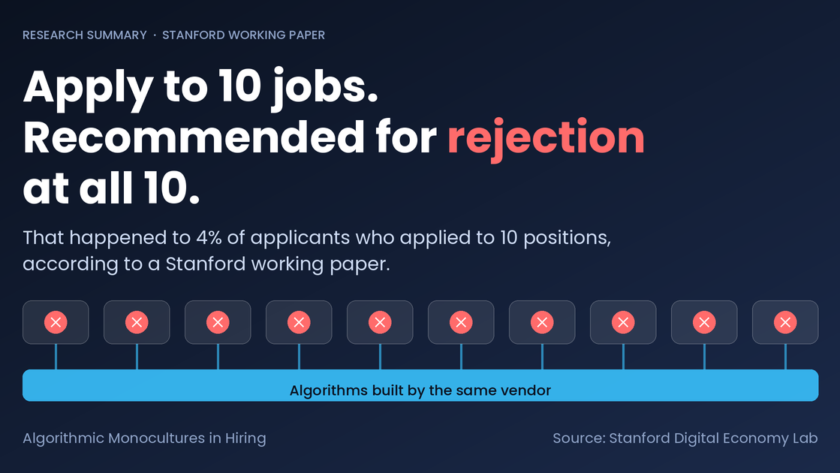
Apply to ten jobs. Get recommended for rejection at every single one. According to a new Stanford working paper, that happened to 4% of the applicants it examined who applied to ten positions, and it happened more often than chance alone would predict.
The finding comes from research on a quiet feature of modern hiring: many employers screen applicants with algorithms built by the same few vendors. The paper, Algorithmic Monocultures in Hiring, asks what that means for job seekers. Here is what the authors report, how to read their numbers, and what their summary leaves open.
What is algorithmic monoculture in hiring?
The paper’s starting point is a simple observation: many employers use algorithms from the same few vendors. That is the setting behind the term algorithmic monoculture. The authors hypothesize that this leads to the same individuals, and members of the same racial groups, facing rejection again and again. Put simply, if a shared vendor’s algorithm turns someone away at one employer, it may do the same at others.
Who wrote it, and how final is it?
Stanford Digital Economy Lab lists the paper as a working paper dated May 26, 2026. The authors are Rishi Bommasani, Sarah Bana, Kathleen A. Creel, Dan Jurafsky and Percy Liang. Because it is a working paper, treat the figures below as the authors’ reported findings, and check the full text before you cite them anywhere important.
How big is the dataset?
The researchers say they acquired and analyzed a novel dataset of 3 million applicants submitting 4 million applications. Every one of those applications was screened by algorithms built by the same vendor, which is central to the question the study asks. The summary does not name the vendor or the employers.
What did the study find about race?
The authors report clear racial disparities in applicant outcomes. The numbers are easy to misread, so here is what the summary actually says.
Of all applications submitted by Asian applicants, 14.74% went to positions that adversely impact Asian applicants. For Black applicants, the figure is 25.87%. Both are judged against U.S. employment discrimination standards, which the summary cites without spelling out.
Those percentages describe where applications were submitted, not the share of people who were rejected. Even so, the contrast is clear: about one in four applications from Black applicants went to such positions, versus nearly 15% for Asian applicants.
Do the same people get rejected over and over?
The second finding is about individuals, not groups. The authors report that 4% of all applicants who apply to 10 positions are recommended for rejection from all of them, a rate higher than expected by chance.
Four percent can sound small. The detail doing the work is the comparison with chance: if outcomes were scattered randomly across positions, fewer applicants would be shut out everywhere. The summary does not give the chance baseline, so you will need the full paper for that number.
What if an applicant applied to every position?
The authors used a property of hiring algorithms that the summary describes as deterministic replicability. In plain terms, the algorithms can be rerun to produce consistent results. That let the team generate the outcomes applicants would have received if they had applied to all positions.
Their conclusion is practical: applicants would need to apply widely to ensure their applications are considered by a human.
Why does it matter?
Read together, the findings point to two risks when many employers share screening tools. One is at the group level: racial disparities in outcomes. The other is at the individual level: some applicants may be recommended for rejection by every position they apply to. The closing line adds a practical twist. If outcomes are this consistent, reaching a human reviewer may mean applying widely, which puts extra work on applicants.
The summary offers no policy recommendations, so we will not invent any.
What the summary does not say
The summary on the lab’s page does not name the vendor, the employers or the time period. It does not describe which jobs were involved or how the algorithms reach their recommendations, and it does not claim the results would hold for other vendors. If the paper answers any of that, the answers are in the full text.
Where can you read the paper?
Start with the summary on the Stanford Digital Economy Lab page. It links to a GitHub site for reading the publication.
Frequently asked questions
What is algorithmic monoculture in hiring?
It is the situation where many employers screen applicants with algorithms built by the same few vendors. The paper hypothesizes that it leads to the same individuals, and members of the same racial groups, facing rejection.
How large is the dataset in the Stanford study?
It covers 3 million applicants and 4 million applications, all screened by algorithms built by the same vendor.
What does the 4% figure mean?
Of all applicants who apply to 10 positions, 4% are recommended for rejection from all of them. That rate is higher than expected by chance.
Who wrote the paper?
Rishi Bommasani, Sarah Bana, Kathleen A. Creel, Dan Jurafsky and Percy Liang.